
![[Beautiful UESTC: The Beauty of Innovation] Exploring the Last “Virgin Land” of Electromagnetic Waves](https://thz-cdn.mjthz.com/wp-content/uploads/2021/08/thz-virgin-land-0.jpg)
Editor’s Note: On August 17, 2021, page 12 of the “Science and Innovation Future” section of Sichuan Daily published an article titled “Cultivating the Last ‘Virgin Land’ of Electromagnetic Waves,” providing an in-depth report on Academician Shenggang Liu, hailed as the “Father of Chinese Terahertz,” and his endeavors and achievements in the field of terahertz research. The full text is as follows:
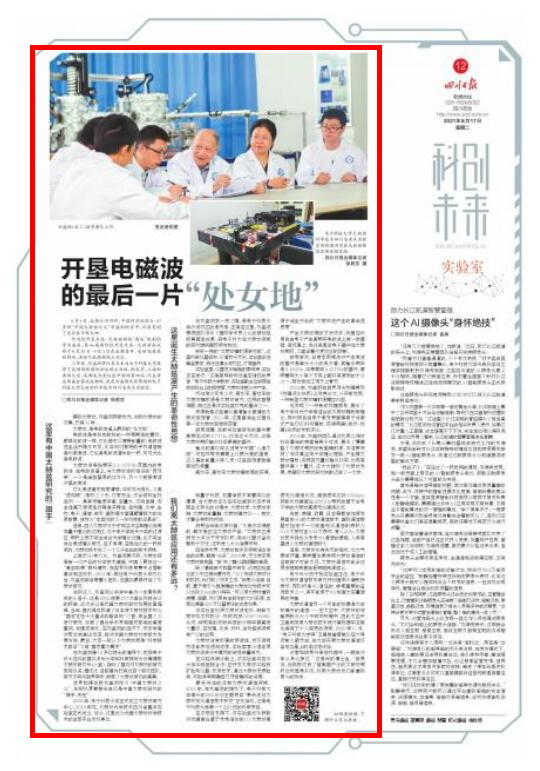
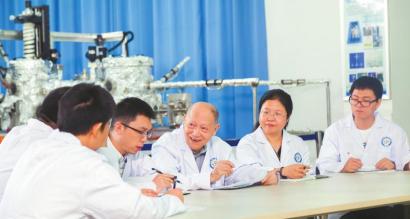
On August 9, by the banks of the Shahe River in Chengdu, the reporter met this eminent authority, the 87-year-old Academician Shenggang Liu, the “Father of Chinese Terahertz” of the Chinese Academy of Sciences, at his home.
As the “Olympic”-level academic event in the field of infrared, millimeter-wave, and terahertz science, the 46th International Conference on Infrared, Millimeter, and Terahertz Waves (IRMMW-THz) was scheduled to be held in Chengdu from August 29 to September 3. Due to sporadic COVID-19 resurgences in China driven by the Delta variant, the conference had to move entirely online.
“The effectiveness of the event may be affected, but there’s no way around it. I believe science will eventually conquer the virus, and every scientist must strive for that,” said 87-year-old Shenggang Liu helplessly.
Three years ago, at the age of 84, he led a delegation to Japan to bid for the hosting rights of the “Olympics” of terahertz conferences, edging out Australia by just two votes to secure China’s right to host this top-tier international conference. Following Beijing, Shanghai, and Hong Kong, Chengdu became the fourth city in China to host the conference. It not only gave the international community a deeper understanding of China’s terahertz research strength. The driving force behind bringing this grand event to Chengdu was Shenggang Liu and the Terahertz Science and Technology Key Laboratory of Sichuan Province at the University of Electronic Science and Technology of China (UESTC), which he leads.
A pioneer in China’s terahertz research.
When terahertz is mentioned, Shenggang Liu’s eyes light up with excitement—he has been involved with terahertz for 31 years.
Terahertz is the last “virgin territory” on the electromagnetic spectrum. Electromagnetic waves are periodic oscillations of electric and magnetic fields, and like other waves they can carry energy. Electromagnetic waves are everywhere in daily life: for instance, the mobile communication we use every day relies on microwaves—a portion of the electromagnetic spectrum—and visible light is also an electromagnetic wave.
In the electromagnetic spectrum, the terahertz band is flanked by its “two brothers”: one is the infrared light used in remote controls, and the other is the microwave radiation found in microwave ovens.
It sees things more clearly than microwaves; compared to visible light, it functions as a “penetrating eye”; and compared to X-rays, it is safer, causing no damage to biological tissues… It boasts high transmission rates, large capacity, strong directionality, high security, and excellent penetration. It holds enormous application potential in physics, chemistry, biology, electronics, communications, aerospace, national defense, and other fields, and is hailed as “another cutting-edge revolution of this century.”
However, because the terahertz band sits at the transition from classical macroscopic physics to microscopic quantum theory, and from electronics to photonics, it is neither fully amenable to optical theory nor to microwave theory. Combined with the difficulty of accessing this frequency range, terahertz technology remained a nearly uncharted field for a long time.
In the early 1990s, Shenggang Liu realized that terahertz would become the scientific and technological foundation for the next generation of industries, and that Chinese researchers needed to make their mark in this “uncharted territory” to gain the commanding heights and seize the initiative in the global science and technology race. In 2001, after stepping down as president of the University of Electronic Science and Technology of China (UESTC), Shenggang Liu personally led a small team to launch terahertz research in China—the earliest such effort in the country.
Speaking of this, Shenggang Liu took out a yellow-covered booklet from his study. It was the report of the 270th Xiangshan Science Conference in 2005, a milestone in the development of terahertz research in China. That year, domestic media reported that Japan had designated terahertz technology as the first of its “Ten Key Strategic Goals of National Pillar” and was mobilizing nationwide efforts for its research and development, drawing high-level attention from both Chinese academia and national ministries. Entrusted by the state and under the organization of Shenggang Liu, experts and scholars gathered at the Xiangshan Hotel in Beijing to explore the future direction of terahertz science and technology in China. In the end, they reached a consensus that terahertz is both a “frontier of science and technology” and a “major national demand.”
Under the advocacy of over ten academicians including Shenggang Liu, many universities and research institutes in China, including the University of Electronic Science and Technology of China (UESTC), have established terahertz research centers (labs), propelling domestic terahertz research to a deeper level. According to statistics, there are now nearly a hundred research teams in the country, whose research directions are in sync with the world, sparking a surge in terahertz research.
While the academic community and media have dubbed Shenggang Liu the “father of Chinese terahertz,” he himself only accepts being a “standard-bearer and pioneer” of terahertz research in China.
In 2006, the University of Electronic Science and Technology of China (UESTC) officially established the Terahertz Research Center; at the end of 2010, the Sichuan Provincial Key Laboratory of Terahertz Science and Technology was officially established. Today, it serves as the sole platform supporting unit for terahertz science and technology in China.
This is where revolutionary ideas for terahertz wave generation are born.
Just across the river from Shenggang Liu’s home stands the Yifu Building on the Shahe Campus of the University of Electronic Science and Technology of China (UESTC). It was here that Shenggang Liu led his team to achieve original or foundational results recognized by the international academic community, elevating UESTC’s terahertz research to an internationally leading position.
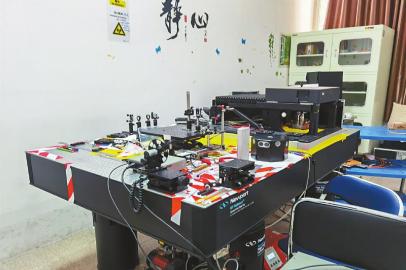
Upon entering the ‘Terahertz Radiation Source Research Department’ on the first floor, you see a dense array of research instruments worth tens of millions of yuan. The laboratory is currently preparing to move; it will relocate to Qingshuihe Campus for a larger space.
In the laboratory, instruments emit a buzzing hum as the experiment continues. “That’s the sound of the superconducting magnet cryogenic compressor,” says Min Hu, a professor at the University of Electronic Science and Technology of China (UESTC) and deputy director of the laboratory, pointing to the gyrotron on the experimental bench, from which terahertz waves are generated.
Even a clever housewife cannot cook a meal without rice. High-power, high-efficiency terahertz radiation sources are the foremost challenge in terahertz research and applications. This is precisely one of the key priorities that this laboratory is working to conquer.
The source is the terahertz gyrotron, which looks like an ordinary water pipe. In 2011, the first terahertz gyrotron in China was born here.
Min Hu revealed that the device currently developed in the laboratory achieves a maximum frequency of 0.7 THz and a power level in the kilowatt range. This is the device with the highest output power in the terahertz frequency band.
The 0.14 THz megawatt-level high-power output is also used in China’s “artificial sun”. Controlled nuclear fusion requires temperatures of hundreds of millions of degrees Celsius. Where does such high energy come from? These gyrotrons are the heating devices.
High-power, high-efficiency terahertz radiation sources are realized thanks to the “revolutionary idea for terahertz wave generation” that originated here.
There are many methods to generate terahertz sources, and China has a certain foundation in utilizing free electrons to produce high-frequency electromagnetic waves. However, in terms of mechanism, when these vacuum electronic devices operate in the terahertz band, they face limitations imposed by scale effects.
Min Hu gives an example: the device that generates microwaves in a household microwave oven is a fist-sized electron tube operating at 2.45 GHz. To create a device for 2.45 THz, the size would have to shrink to one-thousandth in every dimension, making research, development, and fabrication extraordinarily difficult.
In 2012, Shenggang Liu published a paper in *Physical Review Letters*, one of the world’s premier physics journals, unveiling a groundbreaking discovery: a new type of terahertz radiation source burst onto the scene.
He discovered a new physical phenomenon and proposed a novel theory of terahertz radiation that merges electronics and photonics—using free electrons to excite surface plasmons to generate Cherenkov radiation—an achievement highlighted in a dedicated commentary in the journal *Nature Physics*.
In 2014, the team led by Shenggang Liu proposed a novel radiation source covering the entire terahertz frequency band by exploiting surface plasmon waves in the two-dimensional material graphene. This breakthrough transcended the conventional theoretical framework of vacuum electronics, generating intense terahertz radiation and achieving an output power on the order of hundreds of watts—three orders of magnitude higher than existing devices. This significantly advanced the development of terahertz technology and marked a major step forward for international terahertz research.
How far are we from terahertz applications?
Terahertz technology has had a similar experience to quantum technology and graphene. While terahertz is still in the process of transitioning from laboratory research to commercialization, products such as terahertz beds, terahertz bracelets, terahertz energy shoes, and terahertz physiotherapy devices… are already flooding various shopping websites.
Min Hu once put it simply to his mother: “Anything you can afford isn’t a real terahertz product.” Terahertz application R&D is still largely in the development stage, with related instruments and equipment easily costing hundreds of thousands of yuan, and has yet to enter the mass consumer market.
In academia, however, the breakthroughs that emerge from combining terahertz with diverse fields are all headline material. In 2019, astronomers used terahertz detectors to capture an image of a black hole that strikingly resembles a doughnut.
In addition to basic research and device development, this laboratory is also dedicated to application scenario development. “To overcome the terahertz diffraction limit, we have done a lot of work,” said Min Hu. Currently, terahertz near-field technology based on atomic force microscopy can achieve a resolution of 20 nm. “It can be used to see viruses and bacteria with terahertz. Using our self-developed high-power source, we achieve better imaging results than a 5-million-yuan German instrument.”
The laboratory has developed a terahertz-wave-driven dynamic nuclear polarization–nuclear magnetic resonance (DNP-NMR) system, which enhances the resolution of existing nuclear magnetic resonance by two orders of magnitude, offering broad applications in physics, chemistry, materials science, and biomedicine.
Terahertz waves have extremely strong penetrability and can achieve see-through imaging of opaque objects. A group in the laboratory is using terahertz waves to conduct qualitative and quantitative research on Chinese herbal medicines.
In the diagnosis of oral diseases, the laboratory, in collaboration with West China Hospital of Sichuan University, is developing a terahertz oral demineralization detection device. Without the need for tooth extraction, terahertz non-destructive testing can detect early caries and the depth of tooth decay.
The terahertz communication field has also drawn significant attention. In 2011, driven by Shenggang Liu, the 863 Program project “Millimeter Wave and Terahertz Wireless Communication Technology Development,” led by the University of Electronic Science and Technology of China (UESTC), was officially launched. This was the first research project at UESTC with a budget exceeding 100 million yuan.
With support from this project, the laboratory successfully developed China’s first 0.1 terahertz high-speed wireless communication system based on optoelectronic integration, achieving a communication rate of 10 Gbps; and developed China’s first 220 GHz band high‑speed wireless communication system based on all‑electronic terahertz technology.
Currently, the United States, the European Union, Japan, and others are accelerating the development of terahertz communication technology for 6G. The International Telecommunication Union has designated the frequency band for next-generation terrestrial wireless communications as 0.12terahertz to 0.22terahertz. Some believe that terahertz technology will become the foundation of future 6G communications, and humanity is expected to enter the terahertz communication era.
However, terahertz has inherent drawbacks. It suffers from severe atmospheric attenuation, meaning that terahertz communication is necessarily limited in distance. Terahertz communication may find applications in short-range or even ultra-short-range scenarios.
Professor Li Shaoqian, Director of the Anti-Interference Laboratory at the University of Electronic Science and Technology of China (UESTC) and a pioneer of terahertz communication technology research at UESTC, stated that at the present stage, it is one of the potentially very important candidate technologies for 6G and could be used for terrestrial high‑capacity information transmission in 6G.
Another potential scenario for terahertz communication is in space environments—in space, terahertz transmission losses are far smaller than in urban environments, making high-data-rate inter-satellite links using terahertz technology an area many have explored. In November 2020, the University of Electronic Science and Technology of China (UESTC) satellite was launched aboard a Long March 6 rocket to conduct in-orbit adaptability tests of terahertz communication equipment on satellites.
The reporter and Min Hu were walking across campus when a bicycle swept past them. “That’s my doctoral student,” Min Hu said. He has just achieved a breakthrough in the first domestically developed terahertz-band near-field microscopy system. With terahertz, we can see smaller objects.
Report link: https://epaper.scdaily.cn/shtml/scrb/20210817/260124.shtml
Source: the University of Electronic Science and Technology of China (UESTC) UESTC News Network (reposted from Sichuan Daily)View original text