
Painted in 1777, *The Sacrifice to Vesta* is one of the early masterpieces by Spanish painter Goya. Over 240 years later, some of the painting’s secrets have faded with time, concealed beneath deepening layers of pigment and varnish.
With the aid of modern technology, mysteries hidden from the naked eye have been brought to light. In 2013, scientists in Barcelona used a Mini-Zterahertz time-domain spectroscopy system to scan and image the painting, and after analysis they discovered a trace beneath its surface.
Upon comparison, the signature matches those known from Goya. The researchers deduce that this is the earliest pencil mark left by the painter, originally on the back of the canvas and later covered. Compared to other electromagnetic detection techniques, terahertz is more sensitive to the molecular composition of materials; as a result, in reflection imaging, the structures of the pencil signature, the surrounding canvas, and the paint each exhibit a different “expression,” making them distinguishable.
The discovery of the signature provided the most compelling authentication for the painting. This study is regarded as one of the classic examples of terahertz technology applications.
In the field of cultural relic conservation and archaeological research in China, terahertz technology offers more diverse application scenarios and broader prospects. The key enabling technologies for terahertz applications — terahertz imaging and spectroscopy — have demonstrated clear advantages in nondestructive testing of cultural relics and material analysis, attracting increasing attention.
In recent years, at the Terahertz Research Center (hereinafter referred to as the Research Center) of the University of Electronic Science and Technology of China (UESTC), researchers have also opened up this “track,” hoping to forge more unexpected connections with the splendid ancient Chinese civilization.
Nondestructive testing: terahertz technology holds great promise.
In 2018, while attending a Zhejiang University alumni gathering, Professor Min Hu, head of the research center, struck up a conversation with Professor Zhang Hui from Zhejiang University’s School of Art and Archaeology about the study of ancient Chinese murals.
Zhang Hui mentioned the mural-making process in Kizil, Xinjiang: ancient people typically applied a layer of glue first, and then brushed on the pigments. This glue was a type of lipid extracted from plants or animals.
“Can terahertz technology be used to identify these lipids and, through comparison, determine whether they originated from the Central Plains or India?” The sudden question from the interlocutor instantly opened up Min Hu’s thinking.
To enable in-situ, non-destructive examination of cultural artifacts, researchers commonly employ electromagnetic wave techniques—such as X-ray, ultrasonic, infrared, and Raman spectroscopy—to probe internal structures, verify authenticity, and analyze composition.
However, in a “little-noticed corner” of the electromagnetic spectrum, terahertz waves (electromagnetic waves with frequencies in the range 0.1~10THz and wavelengths in the range 3 ~0.03mm) also have their unique advantages.
“Compared with ultraviolet and infrared light, terahertz radiation is penetrating to many dielectric materials and non-polar substances, such as ceramics, wood, soil, and cardboard, and is strongly reflected by metallic objects,” said Min Hu. “Moreover, the photon energy of terahertz radiation is only one ten-thousandth that of X-rays, making it harmless to the human body and unable to cause ionization that would damage cultural relics.”
Moreover, compared to X-rays, terahertz radiation is more sensitive to object layering. Terahertz pulsed radiation, with its picosecond pulse width, can effectively perform time-resolved studies. Without the need to cut into artifacts, researchers can obtain internal layer information from signals reflected between different material layers, enabling tomographic imaging.
The fingerprint-like spectral characteristics of terahertz waves also mean that terahertz technology holds great promise for the detection of cultural relics. The terahertz frequency band encompasses the rotational and vibrational energy levels of a vast array of material molecules, and different molecules exhibit distinct absorption features in terahertz spectra, displaying a fingerprint-like uniqueness.
Currently, the use of terahertz technology to detect gutter oil is based on this principle. “Similarly, we can also identify lipid coatings on murals, or pigment components in paintings,” says Min Hu.
Internationally, “terahertz technology + cultural heritage and archaeology” is nothing new, though it has mostly been used for the examination of paintings. In China, the technology’s potential application scenarios are far richer—lacquerware, murals, clay sculptures …—and a number of researchers have already begun exploring and testing these possibilities.
“Starting with Academician Shenggang Liu of the Chinese Academy of Sciences, successive generations of our team have been deeply engaged in terahertz research for over twenty years,” explains Min Hu. During this period, the team initially focused on fundamental technical theories and devices, then gradually built some simple demo systems, and also explored application scenarios such as oral medicine and cell imaging. “But I always feel that the scope of applications we’ve expanded is still not sufficient.”
After talking with an alumnus, he formulated a plan: “Perhaps archaeology is a new opportunity?”
Decoding Sanxingdui: Revealing Information Beyond the Naked Eye
After establishing contact with the School of Art and Archaeology at Zhejiang University, and with their facilitation, in 2019, Min Hu and his team initiated exchanges with the Sichuan Provincial Institute of Cultural Relics and Archaeology and the Sanxingdui Museum. This later led to cooperation in archaeological research, cultural relic preservation, and cultural heritage inheritance.
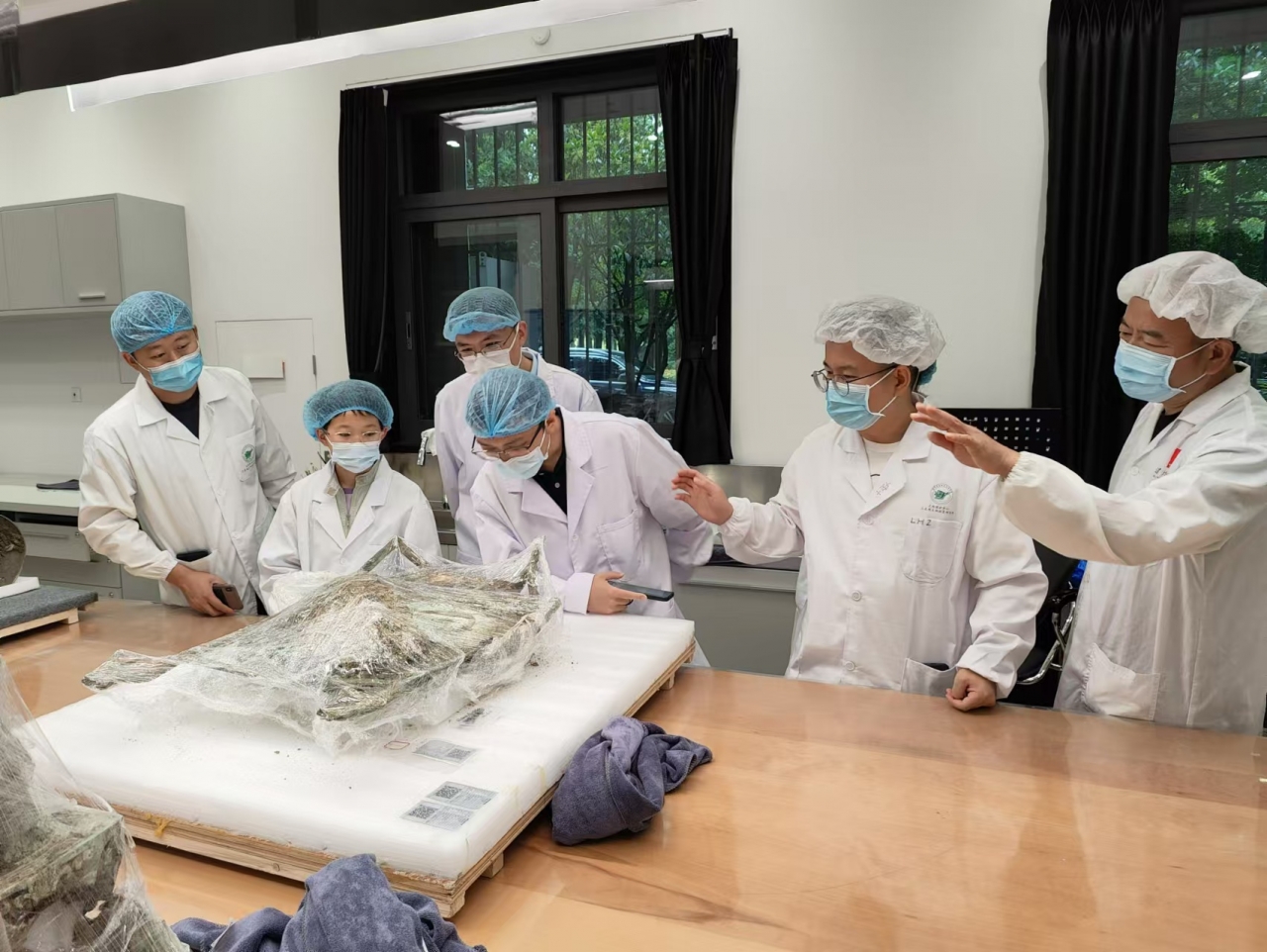
After bronze artifacts are unearthed, they typically develop a blue-green copper rust layer. The thickness, composition, and layered structure of this rust layer can all be determined using a terahertz time-domain spectroscopy instrument.
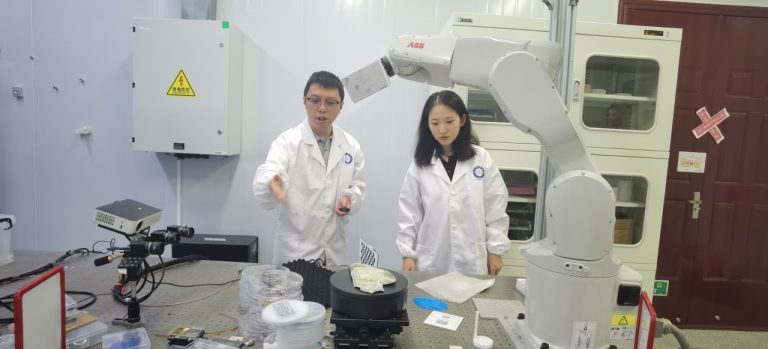
In the research center’s laboratory, the reporter saw the terahertz pulse-emitting terminal—a robotic arm that controls the detection probe, with its internal program independently developed by the research center.
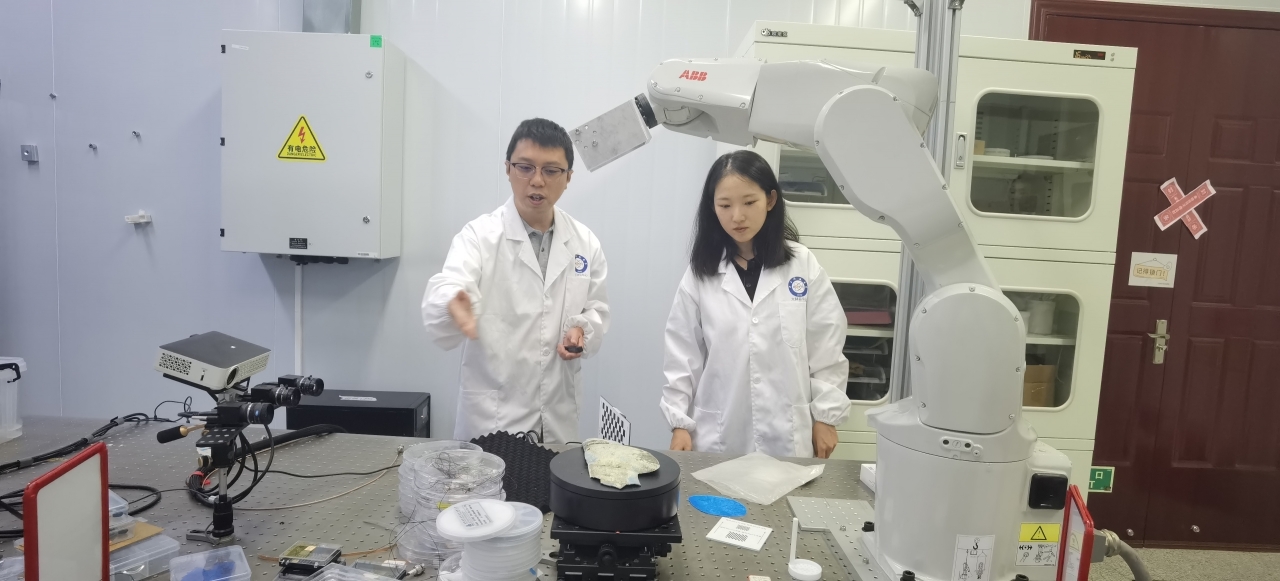
After the system starts up, the robotic arm plans a path based on the algorithm and performs non-contact, point‑by‑point scanning along the normal direction of the cultural relic sample below. “To precisely determine the thickness of the rust layer, or to obtain layering information, the robotic arm constantly keeps the ‘transmitter–receiver head’ perpendicular to the sample surface,” explains Min Hu.
“The principle of measuring rust layer thickness is similar to that of laser ranging,” he explained. The difference is that terahertz waves are penetrative; the same beam produces corresponding reflection signals at different interfaces within the sample, which appear as distinct peaks in the time‑domain terahertz spectrum. “By taking the delay time between two peaks, together with the speed of light and the refractive index of the rust layer, we can calculate the thickness of the rust layer.”
Recently, our work on rust layer thickness measurement encountered an intriguing interlude. During the excavation in Pit 3, a rare pale yellow appeared on the corrosion layers of bronze artifacts. Laboratory analysis confirmed it to be lead-tin yellow. According to known records, the use of this yellow pigment dates back only to the early 14th century, where it was commonly employed as a pigment in enamelware and oil paintings.
But lead-tin yellow must be artificially prepared and requires extremely high temperatures. Researchers couldn’t help but wonder: where did this type of yellow come from on Sanxingdui bronzes dating back around 3100–5000 years?
For this purpose, the research center measured the thickness of the lead-tin yellow on the sample.
“The distribution is very even!” Upon first seeing this result, team member Zhuang Yuxuan was extremely excited: “If it were naturally formed, under different humidity environments, the rust layer would certainly be uneven in thickness. Perhaps this really was artificially applied.” However, after the team discussed the thickness measurements and chemical reduction results with archaeological experts, he realized that “there is still a long way to go.”
“At present, we can only preliminarily infer that the formation of this yellow hue might have involved human intervention,” said Min Hu. However, whether it was deliberately prepared as a pigment or resulted from natural corrosion still requires further discussion and investigation.
Zhuang Yuxuan feels strongly about this: because the results of technical testing are intuitive and absolute, one may feel that the truth is within reach, yet in reality it is still far away. This also allows this group of science and engineering scholars to experience the delight of painstakingly teasing out the threads of history.
The nondestructive analysis of patina composition on bronze artifacts is also an important part of the research center’s interdisciplinary archaeology work. Within the patina layer, copper chloride components are corrosive to cultural relics, whereas copper carbonate forms a “protective film” that slows the oxidation and corrosion of bronze. Determining the nature of the patina layer is therefore highly significant for cultural heritage preservation.
In the past, archaeologists, in an effort to minimize damage to artifacts, would carefully scrape a tiny amount of powder from an inconspicuous edge and send it for Raman spectroscopy analysis to determine its composition.
“Now, when the robotic arm directs beams of light waves invisible to the human eye onto the rust layer, we obtain fingerprint spectral information of its molecular structure from the return signal, enabling us to infer whether it is ‘good’ rust or ‘bad’ rust,” said Zhang Xiaoqiuyan, a member of the research center and a doctoral student. She noted that the center is building a standardized database of terahertz fingerprint spectra for material compositions to provide a reference for this identification work.
Let terahertz waves “see” more clearly
Our successful exploration of new application scenarios for terahertz technology is built on the team’s solid foundation of basic research.
Addressing the shortcoming of low terahertz wave power, the team has solved the problem of high-power radiation sources. “This is also the capability that got us started,” explained Zhang Xiaoqiuyan. Terahertz power, also referred to as dynamic range, is a key parameter in terahertz technology applications and is directly linked to detection sensitivity.
“Meanwhile, we also overcame the challenge of terahertz super-resolution imaging, and the current imaging resolution can reach 20 nanometers.” At this point, Min Hu recalled a small incident that happened in 2018.
At that time, a near-field optical microscopy system based on terahertz time-domain spectroscopy arrived from Germany and was installed at the research center. Its imaging results were not ideal, so the team decided to modify it.
“Dismantle it?” Looking at the machine that had cost over five million yuan, Zhang Xiaoqiuyan found it hard to bring herself to do it.
“No worries, take it apart!” Min Hu responded without a moment’s hesitation.
Over the following two years or so, the team first built a vacuum radiation source, then refined optical path components and mirrors, gradually gaining a thorough understanding of the system’s physical principles. Step by step, we “incubated” the nation’s first terahertz scattering-type scanning near-field microscope system based on a high‑power radiation source.
Traditional terahertz time-domain spectroscopy imaging is limited by the diffraction limit of the wavelength. As a result, terahertz waves can only “clearly see” objects roughly 300 micrometers in size, making even a single strand of hair difficult to identify.
To this end, in the process of upgrading the original equipment, Min Hu and the team introduced near-field technology. This technique integrates a terahertz system with an atomic force microscope, using the nanoscale atomic force tip to scatter the terahertz near-field from the sample surface, thereby enabling terahertz near-field imaging of the sample with resolution down to the nanometer level.
Min Hu offered an analogy: if the spot size of a terahertz wave were as large as an entire room, researchers would only want to see the response of a cup on a table to the terahertz wave. “Now, we can use a ‘needle tip’ to scan inside this room and obtain the detailed information we desire from every corner of it.”
Based on this technology, the team has achieved nanoscale-resolution terahertz imaging, even enabling them to “see” how individual proteins, single cells, and bacteria respond to terahertz radiation, offering a completely new approach for bacterial identification in biology.
After mastering the terahertz-band near-field microscopy system, Min Hu and the team are now moving from system development toward industrialization. At the same time, they will continue advancing the protection of cultural relics by using higher-resolution terahertz imaging technology. “In addition to non-destructive testing of excavated artifacts from Sanxingdui, we also plan to monitor and study the aging process of pigment components in cultural relics, providing technical support for their restoration.”
News link: https://news.sciencenet.cn/htmlnews/2024/8/528162.shtm
Source: the University of Electronic Science and Technology of China (UESTC) News Network (reposted from China Science Daily)View original text