
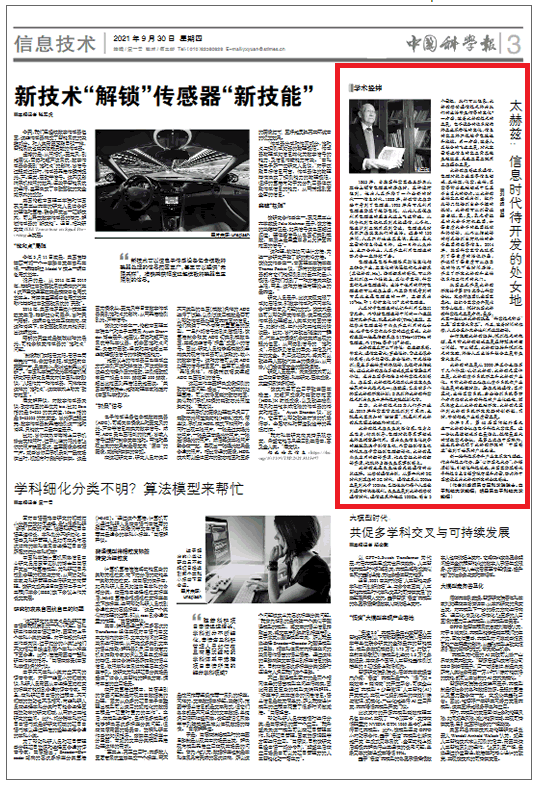
Editor’s Note: On September 30, 2021, the third page of *China Science Daily* published a signed article titled “terahertz: A Virgin Land to Be Explored in the Information Age” by Academician Shenggang Liu and Professor Min Hu from the University of Electronic Science and Technology of China (UESTC). The full text is as follows:
In 1865, when the British scientist James Clerk Maxwell theoretically predicted the existence of electromagnetic waves, he likely never imagined that he was ushering in a brand-new era for humanity—the Information Age. In 1888, Heinrich Hertz observed electromagnetic waves experimentally for the first time, and in 1905, Guglielmo Marconi used them to achieve transatlantic telegraphy. From then on, humanity has been racing forward on the broad avenue of exploiting electromagnetic waves. From radio to television to wireless communication, from cell phones, microwave ovens to the Internet and radar, electromagnetic waves are constantly reshaping our lives. Over the past 150 years, we have relentlessly pursued the goal of faster, farther, and higher-capacity information transmission—a pursuit that has never ceased and never will. Humanity’s effort to explore and harness electromagnetic waves will continue indefinitely.
Electromagnetic waves are generated by the periodic variation and mutual coupling of electric and magnetic fields. The rate of this variation is called frequency (unit: Hertz, Hz). By arranging frequencies from low to high along an axis, much like a family tree, scientists refer to this as the electromagnetic spectrum. All electromagnetic waves used in daily life can be placed on it. In fact, the visible light perceived by the naked eye is also a type of electromagnetic wave, with a frequency of 1015Hz, meaning an electromagnetic wave that changes 1015 times per second.
Humans have extensively explored and utilized electromagnetic waves, yet one band in the middle of the electromagnetic spectrum remains largely underdeveloped—the terahertz (THz) band. Hailed as the virgin territory of the electromagnetic spectrum, it lies in the transitional region between electronics and photonics. The terahertz band generally refers to electromagnetic waves with frequencies ranging from 0.1 THz to 10 THz, where 1 THz equals 10^12 Hz.
Terahertz waves exhibit the following characteristics: high carrier frequency, large bandwidth, and massive communication capacity; excellent penetration and high radar imaging resolution; low photon energy, high safety, enabling nondestructive testing; they cover the characteristic spectra of most substances, often referred to as fingerprint spectra. This gives terahertz significant application value across numerous fields, making it a strategic scientific and technological frontier that nations are racing to dominate. In the United States, terahertz technology is recognized as one of the top ten technologies that will change the world; in the European Union, multiple transnational terahertz research programs have been launched; and Japan has placed terahertz science and technology at the top of its ten-year science and technology strategic plan.
In fact, terahertz technology is not as distant from everyday life as one might think. In 2019, scientists observed a black hole for the first time—the well-known “doughnut” image—and that observation was carried out using terahertz astronomical telescopes.
Terahertz technology will also play a significant role in future military domains such as battlefield reconnaissance, stealth and counter-stealth, precision guidance, and electromagnetic warfare. This is because victory in future information-based warfare depends on information dominance, and the key to achieving information dominance lies in mastering control of the electromagnetic spectrum. Terahertz is a spectrum resource that has yet to be exploited; those who first harness terahertz spectrum resources will seize the commanding heights of future military advantage.
Terahertz is also an inevitable choice for future terrestrial wireless communications. Taking mobile communications as an example, from the 2G era to today’s 5G era, data rates have grown from 200 kb to over 100 Mb, already bringing each of us fast and convenient communication. In the future, as we enter the terahertz mobile communication era, data rates will exceed 100 Gb—three orders of magnitude higher. One can imagine what profound changes terahertz mobile communication technology will bring to our lives. On the one hand, with the advancement of terahertz technology, the architecture of electronic devices will undergo a revolutionary transformation, and information exchange will no longer depend on circuit boards and cables. On the other hand, as human society develops at a rapid pace, the demand for high-capacity, high-speed information interaction is becoming increasingly intense, and space-based satellite internet is flourishing.
Terahertz has shown enormous potential in information-related fields such as high-speed communications, electromagnetic countermeasures, and remote sensing, as well as in cutting-edge fundamental disciplines including physics, chemistry, biology, and medicine. Taking the terahertz–biology interdisciplinary area as an example: infrared spectroscopy can only detect the vibrations of molecular bonds. Terahertz can measure the vibrational and rotational spectra of large organic groups composed of carbon, hydrogen, oxygen, and nitrogen—such as the group spectra of protein macromolecules—thereby revealing information like the molecular group configuration of organic substances in the form of fingerprint spectra. In 2014, British scientists observed protein folding in vivo for the first time and demonstrated that proteins can survive for extended periods outside the body, opening the door to studying the interaction between terahertz radiation and biological systems.
Our country’s formal research into terahertz began at the 270th Xiangshan Science Conference. Commissioned by the state, the author’s team organized experts and scholars to gather at the Xiangshan Hotel in Beijing to explore the development direction of terahertz science and technology in China. In the end, everyone agreed that terahertz represents both a “frontier of science and technology” and a “major national need.” Moreover, as time goes on, humanity will make even fuller use of this part of the spectrum.
How to overcome the bottlenecks in terahertz radiation and detection technology is a pressing core issue that the terahertz field urgently needs to address. It is foreseeable that breakthroughs in terahertz radiation and detection technology will bring transformative changes to human life and societal development.
The development of terahertz has passed through several stages since 2000: understanding terahertz, development of terahertz components, R&D of terahertz demonstration systems, and industrialization of terahertz. Currently, terahertz is at a critical juncture of transitioning from demonstration systems to industrialization. To advance the industrialization of terahertz technology in four directions—wireless communications, medical devices, biomedical systems, and security detection systems—it is essential to rapidly establish a complete innovation chain spanning terahertz basic research, terahertz components, and terahertz system research, while simultaneously driving high-quality development of related industries.
In September this year, the 46th International Conference on Infrared, Millimeter, and Terahertz Waves (IRMMW-THz) concluded at the University of Electronic Science and Technology of China (UESTC). As the oldest and largest top-tier academic conference in the field, its third convening in China clearly attests that the “Chinese heights” of terahertz research have gained widespread global attention.
A new round of technological revolution and industrial transformation is advancing rapidly. As researchers, we must bear the nation’s overarching interests in mind, intensify original and leading-edge scientific and technological breakthroughs, contribute wisdom and strength to our country’s achievement of high-level sci-tech self-reliance and self-strengthening, and strive to make China a global highland for terahertz research.
(Author Shenggang Liu is an Academician of the Chinese Academy of Sciences and a Professor at the University of Electronic Science and Technology of China (UESTC); Min Hu is a Professor at the University of Electronic Science and Technology of China (UESTC))
China Science Daily (2021-09-30, Page 3, Information Technology)
Report link: http://news.sciencenet.cn/sbhtmlnews/2021/9/365623.shtm
Source: the University of Electronic Science and Technology of China (UESTC) News Network (reposted from China Science Daily)View original text