

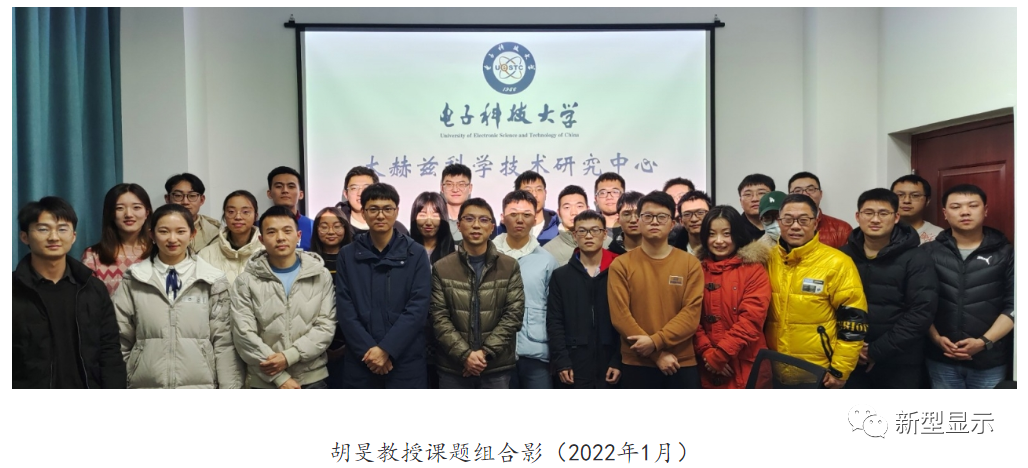
Recently, based on extensive theoretical and experimental work conducted over nearly a decade, the research group of Professor Min Hu, under the team of Academician Shenggang Liu at the Terahertz Center of the School of Electronic Science and Engineering of the University of Electronic Science and Technology of China (UESTC), has for the first time internationally theoretically proposed and investigated the phenomenon of “Tunable Optical Topological Transition in Cherenkov Radiation”.
This research has been published under the title “Tunable optical topological transition of Cherenkov radiation” in a top-tier journal in optics and photonics.Photonics ResearchThe School of Electronic Science and Engineering is the first author affiliation and corresponding author affiliation (and the sole affiliation). Associate Professor Tao Zhao is the corresponding author, and 2018 direct doctoral student Tianyu Zhang is the first author. Co-authors of this paper also include Academician Shenggang Liu, Professor Min Hu, Professor Yubin Gong, Professor Yanyu Wei, Professor Zhaoyun Duan from the School of Electronic Science and Engineering, as well as doctoral students Xiaoqiuyan Zhang, Zhuocheng Zhang, Xingxing Xu, and Yueying Wang from the Terahertz Center.

Taking graphene hyperbolic metamaterials as an example and using free electrons as the excitation means, our group has revealed in detail the fundamental principles and properties of optical topological transitions in Cherenkov radiation, and further proposed two innovative and practically valuable forms of such transitions, corresponding to the ultrafast photothermal effect and the nonlocal effect in graphene, respectively. This work not only provides a standard paradigm for the design and analysis of Cherenkov radiation properties in various novel materials and structures (especially tunable plasmonic materials), but also is expected to promote the realization and application of chip-scale free-electron Cherenkov radiation devices.
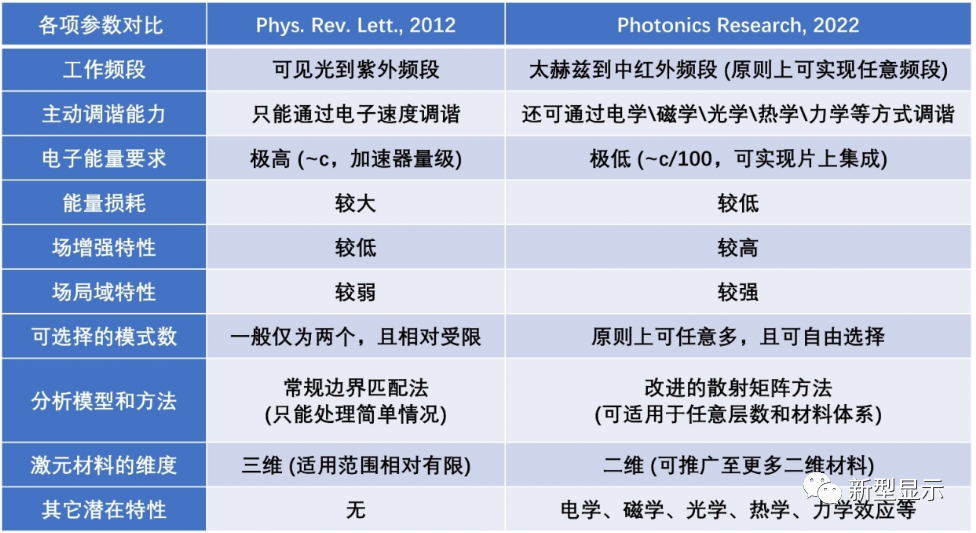
A decade ago, in collaboration with Academician Shenggang Liu’s team, for the first time inPhysical Review LettersCompared with the theoretical concept proposed previously (Physical Review Letters, 2012, 109(15): 153902.), the present work demonstrates significant improvements in all aspects.
The associate editor overseeing the peer review process for this paper was Professor Yuri Kivshar, an internationally renowned expert in optics and photonics and a leading figure in nonlinear physics, nonlinear photonics, and metamaterial physics. All reviewers gave high praise to the quality of this work. The entire review process took only two months, significantly shorter than the journal’s average publication cycle of 124 days.
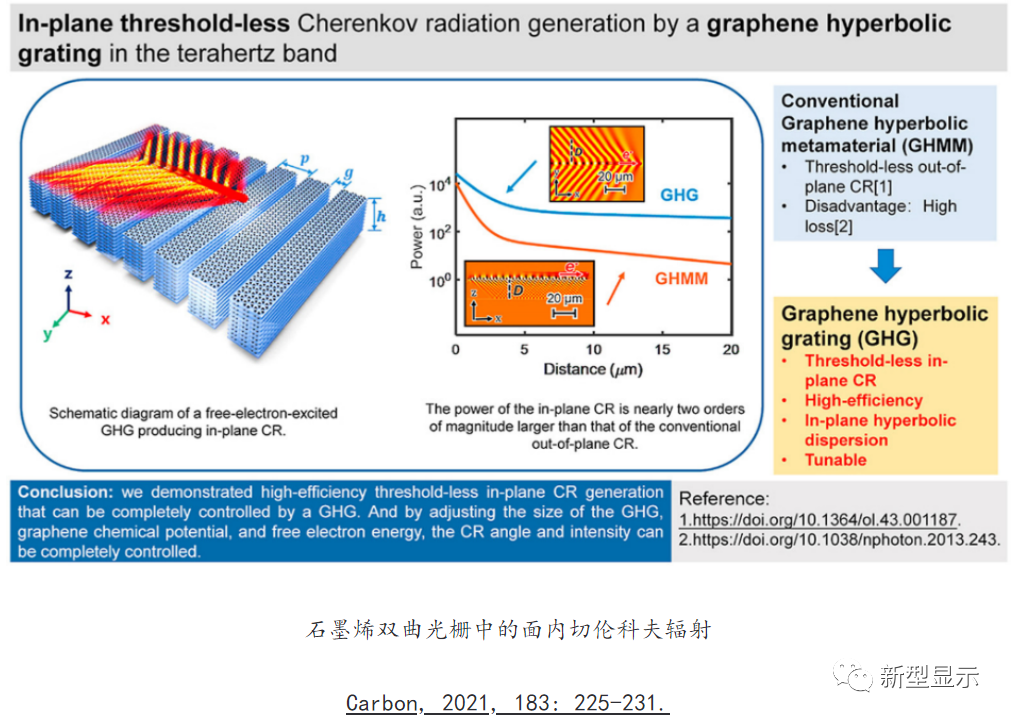
Previously, in 2021, our group theoretically proposed and investigated for the first time internationally “high-efficiency thresholdless in-plane Cherenkov radiation in graphene hyperbolic gratings.” Using a hyperbolic metamaterial with bi‑optical‑axis anisotropy—graphene hyperbolic grating—as an example, we revealed the fundamental principles and properties of in‑plane Cherenkov radiation. The results show that the power of in‑plane Cherenkov radiation in graphene hyperbolic gratings is nearly two orders of magnitude larger than that of out‑of‑plane Cherenkov radiation in conventional graphene hyperbolic metamaterials. Moreover, by tuning the geometric dimensions of the graphene hyperbolic grating, the graphene chemical potential, and the free‑electron velocity, both the Cherenkov radiation angle and intensity can be fully controlled. This study can be integrated with technologies such as on‑chip electron beams and graphene hyperbolic metasurfaces, and is expected to lead to the development of an integrated, compact, free‑electron‑based terahertz radiation source.
This research achievement, titled “High-efficiency threshold-less Cherenkov radiation generation by a graphene hyperbolic grating in the terahertz band,” has been published in a renowned international journal in the field of materials science.CarbonThe School of Electronics is the affiliation of the first author and corresponding author (the sole affiliation). Professor Min Hu is the corresponding author, and doctoral student Zhang Xiaoqiuyan is the first author.
Research Background
Under the leadership of Academician Shenggang Liu, the terahertz center research group has made a series of important advances in this research direction. In addition to the two aforementioned works, other representative achievements include: In 2012, we were the first in the world to reveal the physical mechanism of coherent enhanced Cherenkov radiation in the visible frequency band generated by exciting surface plasmons in metallic materials using free electrons (Physical Review Letters, 2012, 109(15): 153902). Even before its formal publication, this work received high praise from the editors of Nature Physics (Nature Physics, 2012, 8(10): 704). In 2014, in order to shift the frequency of free-electron radiation from the previously visible band down to the terahertz band, we proposed utilizing the interaction between free electrons and a graphene-based dielectric grating structure to generate Smith-Purcell radiation in the terahertz band (Applied Physics Letters, 2014, 104(20): 201104). In 2017, by using a dielectric buffer layer to overcome the limitation that graphene’s intrinsic dispersion cannot directly generate Cherenkov radiation, we achieved plasmonic Cherenkov radiation in the terahertz band (Applied Physics Letters, 2017, 110(23): 231102). Also in 2017, we experimentally observed reverse Cherenkov radiation for the first time internationally using metamaterials with negative refraction properties (Nature Communications, 2017, 8(1): 14901). In 2019, we realized “direction-controllable inverse transition radiation” in the terahertz band using graphene hyperbolic metamaterials (Photonics Research, 2019, 7(10): 1154-1160). All these works have the University of Electronic Science and Technology of China (UESTC) as the first author affiliation and corresponding author affiliation.
Source: the University of Electronic Science and Technology of China (UESTC) News CenterView original text