
Recently, the team led by Professor Min Hu at the Terahertz Research Center of the University of Electronic Science and Technology of China (UESTC), in collaboration with Professor Peining Li’s group at the Wuhan National Laboratory for Optoelectronics, Huazhong University of Science and Technology, has successfully developed a revolutionary “terahertz time-domain-filtered nanoimaging technology (THz-TDF)”. They further collaborated with Professor Hui Zhang’s team from the School of Art and Archaeology and the Laboratory of Art and Archaeology Image Data at Zhejiang University to apply this technique for the first time to nanoscale spectroscopic analysis of ancient painted pigments. The research results were published in the prestigious international journal Nano Letters under the title “Time-domain-filtered terahertz nanoscopy of intrinsic light-matter interactions”, revealing the potential of this technology in nano-optics, particularly the breakthrough achieved in the analysis of pigments in ancient artworks. The University of Electronic Science and Technology of China (UESTC) is the first affiliation, Professor Min Hu is the corresponding author, Professors Peining Li of Huazhong University of Science and Technology and Hui Zhang of Zhejiang University are co-corresponding authors, and the first author is Dr. Xiaoqiu Yan Zhang, a postdoctoral fellow in Min Hu’s group. The study employed the terahertz nanoscale-resolution near-field system independently developed by Chengdu Miji Technology Co., Ltd.
In recent years, terahertz (THz) technology has attracted wide attention due to its enormous potential in fields such as biosensing, security screening, and information communication. Traditional far-field imaging is limited by the diffraction limit, with resolution unable to reach the sub-millimeter scale. To overcome this, near-field optical microscopy techniques focus incident THz waves to a nanoscale volume via a metallized tip, thereby probing THz optical properties at the nanometer scale. However, due to the long wavelength of THz radiation, resonant surface waves generated on the tip and cantilever can mask the sample’s intrinsic near-field response and hinder further development. In the process of solving the surface-wave interference problem in conventional terahertz near-field imaging, Professor Min Hu’s team completed an innovative time-domain spectroscopy technique and, combined with this time-domain truncation approach, successfully eliminated surface-wave interference, achieving ultrahigh-resolution terahertz imaging.
Technological Innovation: Overcoming Surface-Wave Interference for High-Resolution Nanospectroscopy
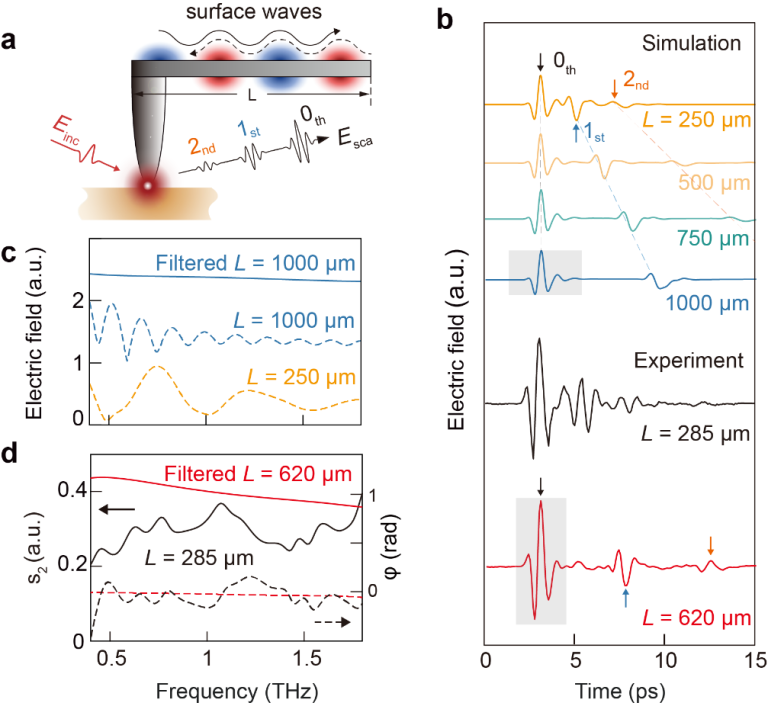
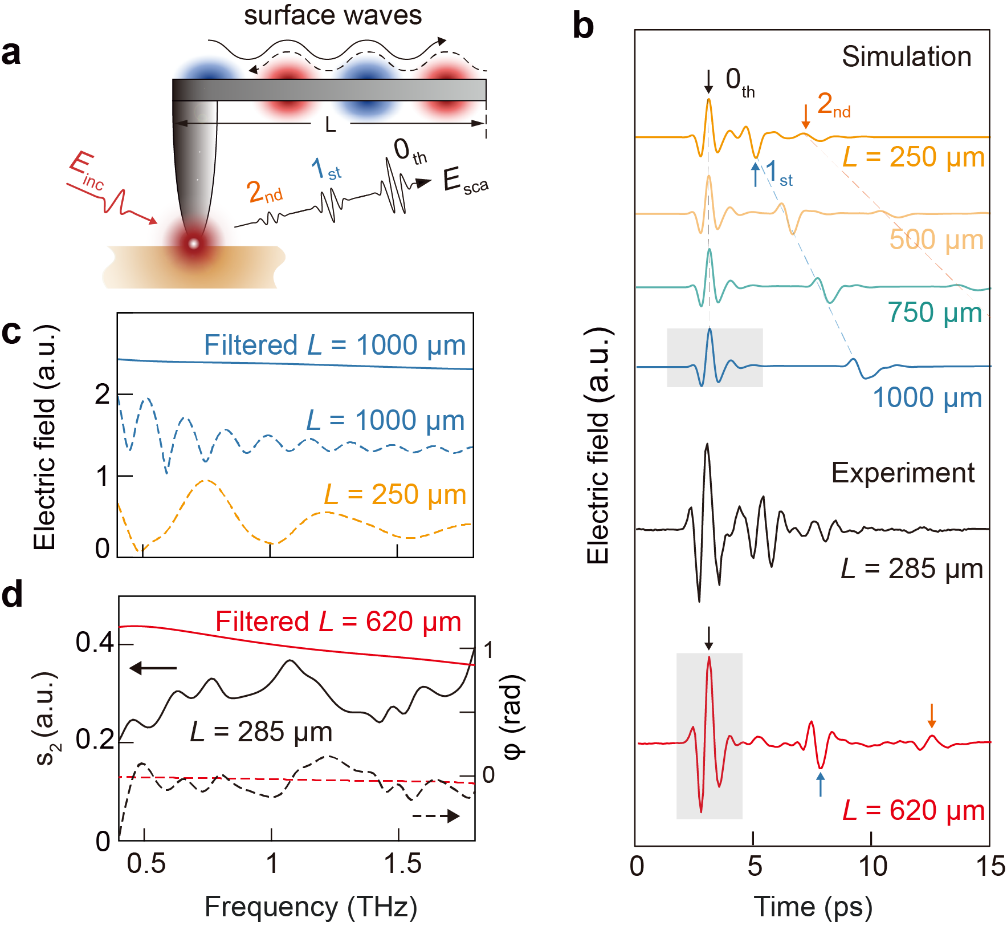
Terahertz waves cover the characteristic spectra of many important materials and are widely applied in materials science, life sciences, and communications. Conventional terahertz nano-optics techniques often fail to accurately extract intrinsic spectral features due to probe-induced surface-wave interference. The research team pioneered a terahertz time-domain-filtered nanoimaging technology that successfully eliminates interference caused by surface waves (as shown in the simulations and experiments of Figure 1), thereby significantly improving the accuracy and resolution of terahertz nanospectroscopy.
Nanoscale Spectroscopic Revelation of Ancient Painted Pigments: Distinguishing Cinnabar and Red Lead
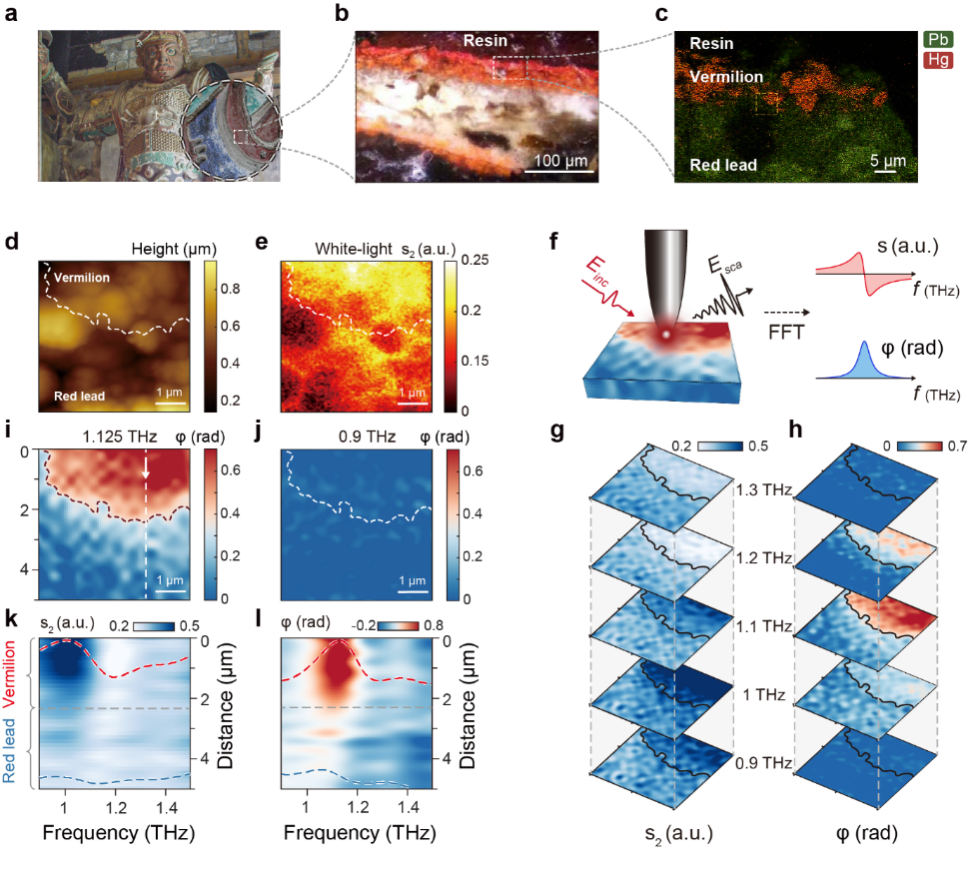
Using this technology, the research team conducted in-depth analysis of a pigment sample from a Ming Dynasty painted sculpture and successfully identified the nanoscale vibrational signatures of cinnabar (α-HgS) and red lead (Pb₃O₄), revealing that at a frequency of 1.125 THz, only cinnabar exhibits a significant vibrational resonance. Cinnabar and red lead are commonly used ancient painting pigments that may discolor under external influences, yet the mechanism remains highly debated. This study achieves, for the first time, terahertz near-field spectroscopic imaging of ancient painted pigments, helping to observe at a smaller scale how these semiconducting pigments react under conditions such as illumination, thereby more precisely understanding pigment discoloration patterns and providing a scientific basis for the preventive conservation of polychrome cultural relics. The technique achieves a spatial resolution below 200 nm, and the nanoimaging results of the ancient pigment sample are shown in Figure 2.
More Applications of THz-TDF Nanoimaging: Optical Study of Metal Antennas
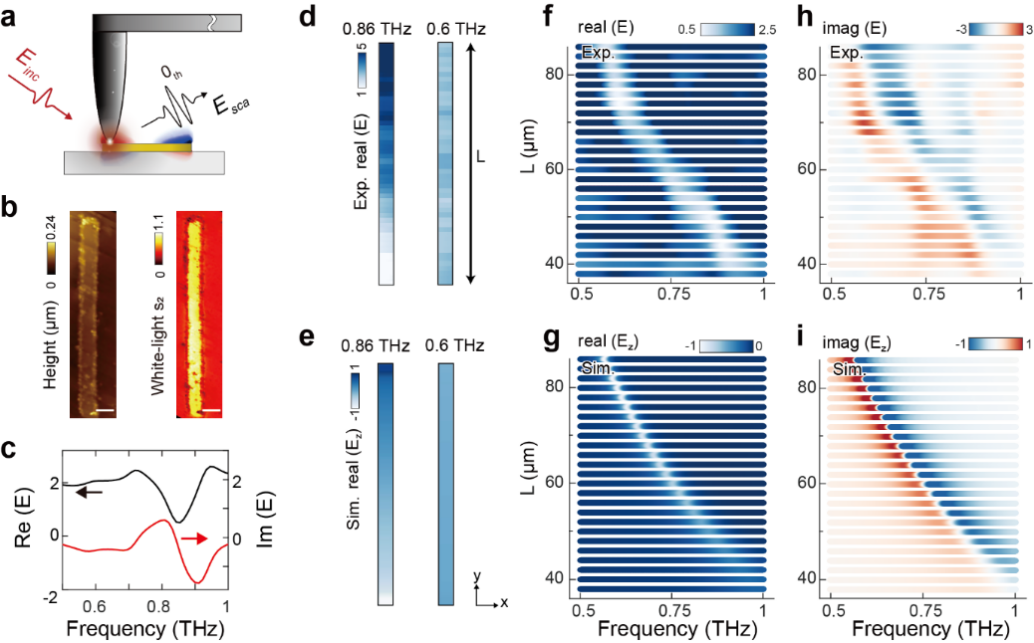
In addition, the research team also employed the THz-TDF nanoimaging technique to investigate the nano-optical properties of metal antennas. The experimental results demonstrate that the technique can clearly distinguish resonance frequency shifts for metal antennas of different lengths and successfully reveal the dipole resonance modes of the antennas. By analyzing metal antennas with lengths ranging from 38 μm to 86 μm, the researchers found that increasing antenna length induces a redshift of the resonance frequency, highly consistent with numerical simulations, showcasing the potential of this technology in nanophotonics research (simulation and experimental results are shown in Figure 3).
Future Outlook: Advancing Terahertz Nano-Optics Technology
In the future, by directly integrating terahertz emission and detection capabilities into the probe tip, more miniaturized and efficient nanoimaging systems can be expected. This technology will provide robust support in fields such as quantum materials, nanophotonics, and cultural heritage conservation, driving terahertz nano-optics toward broader application scenarios.
Paper link: https://doi.org/10.1021/acs.nanolett.4c03715
Research group homepage: https://thz-sci.com/
Chengdu Miji Technology Co., Ltd.: https://www.mjthz.com/
Source: UESTC News Network View original article